Tennis is a game of continuous adjustments, technical precision, and physical stamina. While athleticism can save a player from difficult positions, mastering the core fundamental mechanics dictates long-term consistency and strategic growth. Every single stroke, movement pattern, and tactical shift on a tennis court depends on a complex chain of kinetic energy transfer that begins in the feet and ends at the racket face.
Amateur players often reach a performance ceiling because they favor natural power over mechanical efficiency. By systematically breaking down and mastering the ten most critical tennis techniques, you can minimize unforced errors, dictate the pace of play, and significantly reduce your vulnerability to injury.
1. The Split Step Footwork Routine
The split step is the literal foundation of all tennis movement. It is a light, dynamic hop executed just as your opponent makes contact with the ball. This movement neutralizes your momentum, balances your center of gravity, and primes your nervous system to explode in any direction.
Failing to split step leaves a player flat-footed, forcing them to react late to deep or wide shots. To execute this correctly, push off the ground slightly so your feet are mid-air as the opponent strikes the ball, landing on the balls of your feet just as you identify the ball’s direction.
2. The Continental Grip Utilization
Often referred to as the hammer grip, the Continental grip is a non-negotiable prerequisite for serves, volleys, overhead smashes, and slice shots. To find this grip, place the base knuckle of your index finger on the second bevel of the racket handle.
Many developing players resist using this grip because it initially feels unstable compared to a flat forehand grip. However, mastering the Continental grip is the only way to generate the wrist snap required for heavy service spin and the open racket face angle needed for stable, crisp low volleys.
3. The Modern Topspin Forehand
The modern forehand is an aggressive weapon that relies on heavy topspin to keep fast-moving balls inside the boundaries of the court. To achieve this, most contemporary players utilize an Eastern or Semi-Western grip, which naturally angles the racket face downward.
The movement requires a low-to-high swing path, brushing up the back of the ball during contact. Focus on keeping your wrist loose and relaxed during the backswing, allowing the racket head to lag behind your hand before exploding forward and finishing the follow-through high across your opposite shoulder.
4. The Two-Handed or One-Handed Backhand Drive
Whether you choose a classic one-handed backhand or a stable two-handed variation, the core mechanic rests on early preparation and full shoulder rotation. For the two-handed backhand, the non-dominant hand behaves essentially like a left-handed forehand, providing the primary driving force.
For the one-handed variation, the non-dominant hand acts as a crucial counterweight, pulling backward as the hitting arm extends fully forward into the court. Both variations require you to strike the ball well out in front of your front hip to prevent the racket face from twisting upon impact.
5. The Flat and Spin Service Mechanics
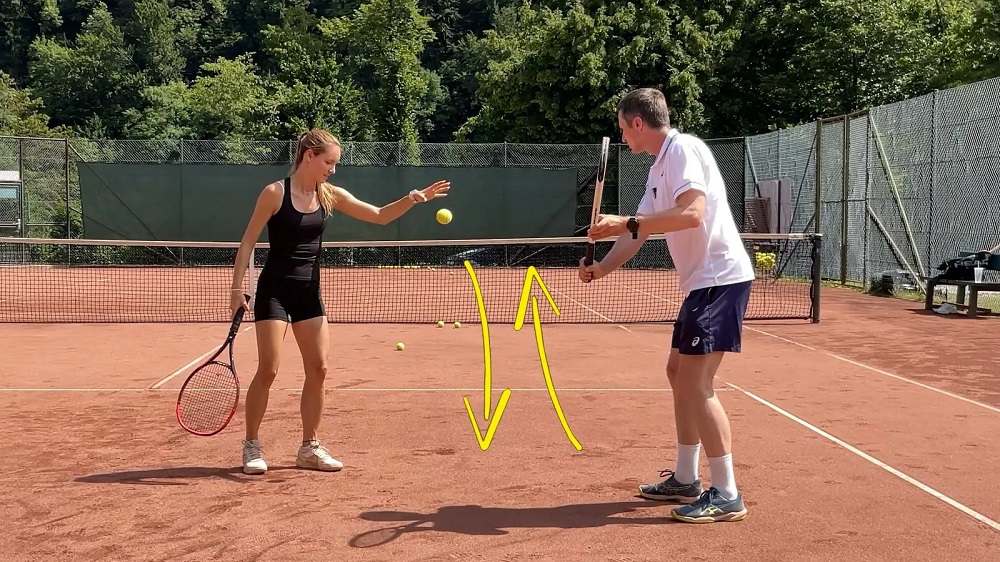
The serve is the only shot in tennis over which a player has absolute control. A dominant serve relies heavily on a consistent, predictable ball toss. The toss should guide the ball slightly into the court and forward of your dominant shoulder, allowing your body weight to move naturally into the shot.
-
Flat Serve: Hitting directly through the center of the ball for maximum downward velocity.
-
Slice Serve: Brushing the outer edge of the ball to create a sideways curve that pushes the returner wide.
-
Kick Serve: Brushing the ball upward from low to high to create heavy forward rotation, causing the ball to jump high and away upon hitting the ground.
6. The Low and High Volley Technique
Volleys require a completely different mental and physical approach than baseline groundstrokes. Because you are standing close to the net, you have very little time to react, meaning you must completely eliminate any traditional backswing.
Keep your racket head high, locking your wrist firmly in place using the Continental grip. Instead of swinging at the ball, think of the volley as a brief, authoritative punching motion, stepping forward with your opposite foot to intercept the ball early and block it back deep into the open court.
7. The Defensive and Offensive Slice
The backhand slice is a highly versatile tactical tool used to alter the rhythm of a rally, buy time during defensive recovery, or draw an aggressive opponent out of their comfort zone.
By utilizing a high-to-low cutting motion with an open racket face, you impart heavy underspin on the ball. This spin causes the ball to travel smoothly over the net and stay incredibly low to the ground upon bouncing, forcing your opponent to bend their knees deeply and hit upward against their natural geometry.
8. The Overhead Smash Execution
The overhead smash is the definitive answer to a weak, short lob. While it looks structurally similar to a serve, the primary challenge is tracking a ball falling vertically through the air while moving backward dynamically.
The moment you spot a lob, turn your body sideways into a tracking profile. Raise both arms immediately, using your non-dominant hand to point directly at the falling ball to gauge its depth, while bringing your racket back into a loaded scratch-your-back position before launching upward to snap through the ball.
9. The Recovery Footwork and Cross Step
Hitting a brilliant shot means absolutely nothing if you fail to recover your position on the court immediately afterward. After running wide to hit a groundstroke, players must utilize a dynamic lateral shuffle or a deep crossover step to return to the center of the baseline.
The first step of your recovery should be an explosive push-off from the outside leg. For long-distance recovery, cross your outside foot directly over your inside foot for one large stride before transitioning into rapid side shuffles as you approach the center mark.
10. The Return of Serve Anticipation
Returning a fast serve requires exceptional reflexes and a compact technical layout. You must stand in a wide, athletic stance with your weight shifted forward on the balls of your feet, holding the racket out in front of your body in a neutral position.
-
Shorten the take-back: Against a high-velocity first serve, completely eliminate your backswing and use a brief blocking motion to redirect the server’s own power.
-
Attack the second serve: When facing a slower second serve, step forward aggressively into the court to catch the ball on the rise, taking control of the point early.
Frequently Asked Questions
Why does my topspin forehand constantly land long past the baseline?
Landing long usually means your racket face is opening up or flattening out exactly at the moment of impact. Ensure you are maintaining a distinct low-to-high swing arc and closing the racket face slightly as you accelerate through the hitting zone, which forces the ball to rotate forward and drop sharply down into the court.
How can I stop my wrist from twisting when hitting a backhand volley?
A twisting wrist is a classic sign of using the wrong grip or catching the ball too far behind your body line. Make sure you are using a strict Continental grip and squeezing the handle firmly right before impact. Focus on striking the ball several inches forward of your body so your shoulder and core absorb the kinetic force instead of your wrist joints.
What is the specific functional purpose of the loop in a modern backhand take-back?
The continuous loop in the backswing helps you build smooth, uninterrupted fluid momentum. By lifting the racket high before dropping it beneath the height of the oncoming ball, you create a natural gravity-assisted acceleration that translates directly into heavy racket head speed without forcing your arm muscles to strain.
How do I adjust my footwork when playing on a clay court versus a hard court?
Hard courts require sudden, high-friction stops using precise adjustment steps to anchor your position. Clay courts possess a loose top layer of crushed brick, requiring you to initiate a controlled slide a few feet before reaching the ball, balancing your weight over your sliding leg so you can change direction smoothly after the hit.
Why do I struggle to generate power on my serves even though I swing very hard?
True service power comes from rhythmic kinetic sequencing, not raw arm strength. If your body movements are disjointed or you tense your muscles too early, you lose significant velocity. Focus on bending your knees to load your lower body, arching your torso slightly forward, and keeping your hitting arm completely loose until the final split second of upward extension.
How can I effectively disguise a drop shot from the baseline?
Effective disguise requires your initial preparation to look identical to a heavy topspin drive. Keep your shoulder turn deep and your racket preparation high until the absolute last fraction of a second. Right before impact, relax your grip pressure, soften your wrist, open the racket face, and gently catch the ball to drop it short over the net.